Case study · SyntheticMe · 2025 to present

An AI twin that
can prove it.

Two hours of voice interview become a twin that answers only from your own approved words, cites the second of tape behind every claim, and says "I don't know" instead of inventing. I researched it, designed it, wrote every line, and deployed it. Alone.

Role
Sole designer and engineer. Research, product, interface, code, infrastructure, deploy.
Stack
Next.js 16 · React 19 · TypeScript strict · Supabase Postgres + pgvector · Tailwind · Playwright · Vercel
Built with
Claude Code, daily, inside a repo with a written engineering constitution and CI that rejects broken work.
Status
Engine deployed and in daily use. Experience layer designed, in build.
6,600
Lines, app + lib + SQL + scripts
42
Commits, deployed on Vercel
117min
Interview protocol, 12 modules
0
Answers without a source
syntheticme.vercel.app/chat
You asked
Why did you throw away the first version?

Because I read it properly and it didn't deserve to ship. Six routes accepted a user id from the client alongside a service key, so any user could have read anyone's memories. There were four different Memory types and stubs returning confidence numbers that were never computed.

For a product whose whole promise is that it doesn't make things up, fabricated confidence is fatal. So I deleted 21,000 lines and rebuilt against rules I wrote down first.

Would you do it again for a client's codebase? I don't know. You haven't told me. Want to answer that now? It will go into tomorrow's questions.

An illustrative exchange, built from things I actually said and wrote. The real corpus is private, which is rather the point. Hover or tap a citation.

01 The problem

Every clone will eventually lie about you.

Fifteen years of "preserve yourself" startups have died or pivoted. Intellitar, Eterni.me, StoryFile's bankruptcy, Eternos' pivot. The survivors sell to creators or enterprises. Nobody fixed the thing that makes the whole category unusable: a clone that confidently invents a memory in your voice is worse than no clone at all. The first time your daughter catches it making something up, every true thing it ever says is suspect.

So the design question was never "how do we make it sound like him." It was "how do we make it structurally incapable of lying about him." That reframing decided the architecture, the interface, and what the product refuses to do.

Every other clonePrompt says "be honest"
Your data, scraped or pasted in
A model improvises in your voice
Confident answer. No receipts.

The guardrail is a sentence in a prompt. Sentences get overruled.

SyntheticMeEvidence or nothing
Your words, on tape, with timestamps
You approve each memory, one by one
Only approved rows can be retrieved
A cited answer, or "I don't know"

The guardrail is a column in the database. Columns can't be talked out of it.

02 Research first

I built the instrument before I built the interface.

The mechanic is real. In 2024 Stanford showed that agents built from a single two hour interview matched their subjects' real answers at 85 percent of the rate people agree with themselves two weeks apart, across 1,052 participants. The result rests on a specific interview instrument, not on a model. So the interview came first.

The protocol is a 117 minute, twelve module script assembled from four validated sources: McAdams' Life Story Interview for narrative identity, the Stanford and Princeton American Voices instrument behind the 2024 result, Aron's escalation gradient for why intimacy has to build in tiers before people stop retreating, and the Adult Attachment Interview's signature move, where you ask for an adjective and then demand the specific episode behind it. The gap between the claim and the episode is the data.

Must stand alone if the session ends early
Depth, bought late with earned trust
Breadth sweeps
  1. 00Framing2 min
  2. 01The story of your life10 min
  3. 02Your life right now12 min
  4. 03Key scenes: the peaks and the pit20 min
  5. 04Your own lens10 min
  6. 05What you value12 min
  7. 06How you decide8 min
  8. 07Where you come from12 min
  9. 08What you believe10 min
  10. 09The deep set10 min
  11. 10Forward and meaning8 min
  12. 11Close3 min

Three design rules fell straight out of the literature. Episodes are the default answer format, never trait self description. Breadth early, depth late. And the first twenty five minutes have to stand alone, because Stanford's ablation showed a fifth of the transcript carries most of the signal, and real people quit. The protocol lives in the repo as a document and again as executable code, with a rule at the top: if the code and the document disagree, fix the code.

03 The decision that is the product

Grounding is a column, not a prompt.

Every competitor treats grounding as an instruction to the model. Instructions are suggestions. So in SyntheticMe, evidence gating is a column in the database.

Each extracted memory carries a status. Only approved rows are retrievable. The retrieval function literally cannot see anything the subject has not personally read and accepted, which means the twin cannot cite a memory that was never approved, no matter what the model would like to say. The guarantee lives in the schema, where a prompt change can't undo it.

The same instinct shaped three more decisions.

Provenance

Dual provenance, or no memory

Every memory stores the transcript span and the audio timestamp range it came from. A memory that can't cite its source span doesn't get created. One day the Why panel plays the clip of you saying it.

Truth order

Explicit beats inferred

What you actually stated lives in its own table and one resolver enforces that it overrides anything the model concluded. Contradictions become questions back to you, never a quiet coin flip.

Unknowns

"I don't know" has a job

Every unknown writes a row to a gap queue, and tomorrow's questions are generated from measured gaps rather than a template. Ignorance becomes the roadmap.

04 The experience

You meet your twin before you build it.

Every capture product opens with a form. This one opens with a camera. The moment you begin, the screen becomes a mirror: your face, softly lit, nothing else. While you talk it reads your expressions and your cadence. Then a second face fades in beside yours, and speaks.

It asks your name. You say it. And from that sentence on, its voice slides toward yours, one line at a time, until "Hello, Amir. It's nice to meet you" already sounds a little like Amir. It asks if you're ready to build your synthetic self. You say yes. Then it asks the first real question, and the two hour interview has begun without ever feeling like one.

The design rule underneath: the interview only works if the person forgets it's an instrument. Everything in the opening minute exists to earn that.

The first sixty seconds Storyboard · built as a working shell
SyntheticMeCamera
SystemThe camera opens. Your face, mirrored. Nothing else on screen.
01 Mirror
SyntheticMeListening
SystemReading expression and cadence while you say hello to yourself.
02 Reading you
SyntheticMeAvatar
Voice match
4%
Avatar"Hello. What's your name?"
03 A second face, not you yet
SyntheticMeListening
Voice match
31%
You"Amir."
04 One word is enough to start
SyntheticMeAvatar
Voice match
78%
Avatar"Hello, Amir. It's nice to meet you. Are you ready to build your synthetic self?"
05 The voice turns toward yours
SyntheticMeModule 1 · 00:00
Voice match
Matched
Avatar"Tell me the story of your life. Start wherever you want, take your time."
06 "Yes." The interview begins

The face is mine. In the shipped shell the avatar is a live second render of the camera feed that sharpens only when something real happens: camera on, name heard, consent given. No percentage is shown in the product, because nothing is measured yet; the frames above show the intent.
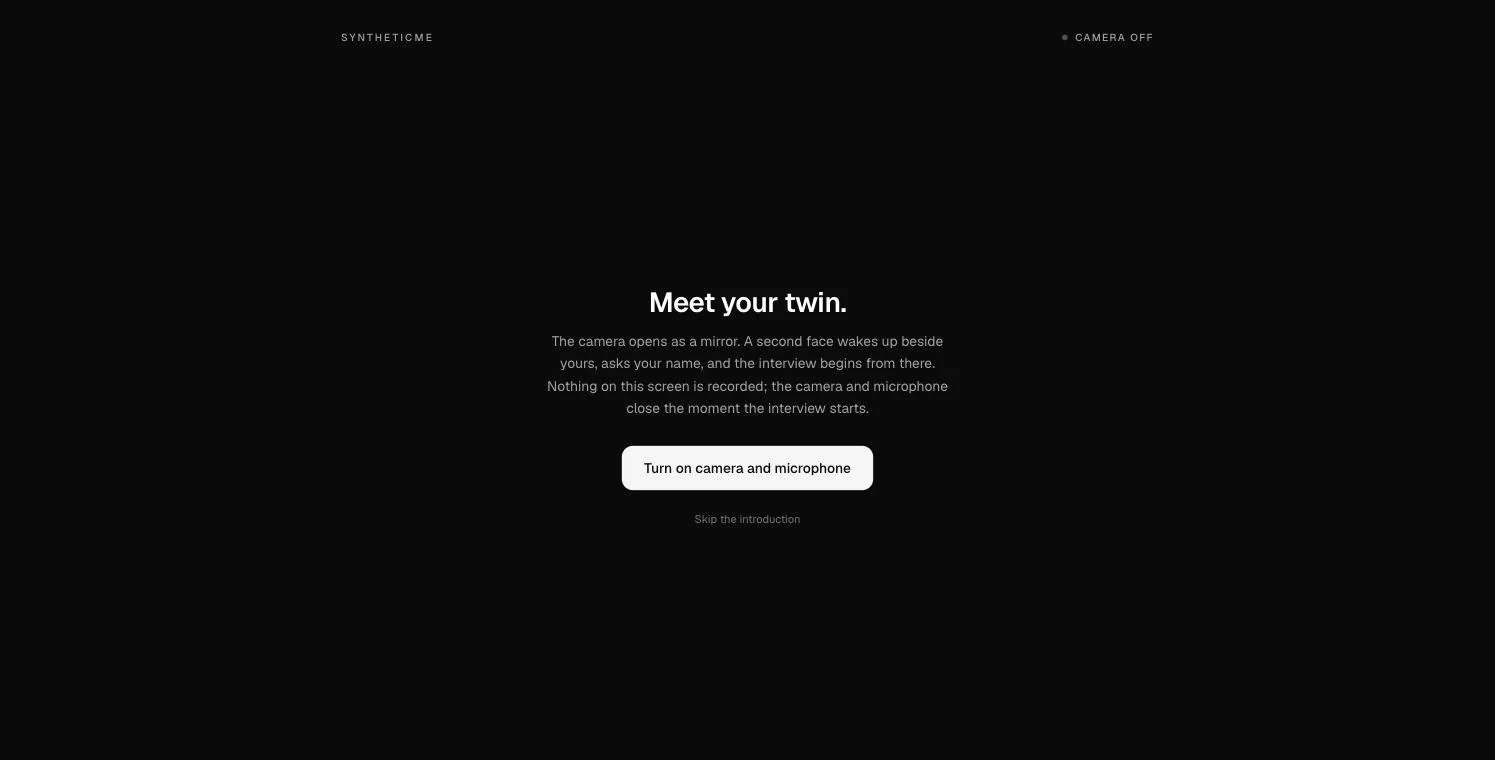
/onboarding
The onboarding intro screen: Meet your twin, one button to turn on camera and microphone
As built. The intro screen. One promise, one button. The camera and microphone close the moment the interview starts.
Built and deployed
  • The evidence engine: extraction, approval gate, hybrid retrieval, answers that cite or decline
  • The 117 minute interview protocol, encoded and running voice first
  • Maturity computed live from coverage, method printed beside it
  • The Personal Turing Test harness with scoped judge links
  • The public sign up, with the five synthetic people moving, and a waitlist that saves
  • The first sixty seconds as a working shell: camera mirror, the avatar that sharpens on real milestones, spoken greeting, name by voice, hand-off into the interview
  • CI on every push, nightly live model verification, nightly archive
Designed, in build
  • Expression reading in the opening minute
  • The voice that slides toward yours (today it speaks in the twin's pinned voice)
  • The avatar as a true likeness rather than a render of the live feed
  • Playable audio provenance in the Why panel
About the running app

What's deployed today is deliberately unstyled: a harness I use every day to test whether the conversation feels natural, whether the twin declines when it should, whether the citations hold. It exists to get the flow right before a single pixel of the surface is committed. That's why it isn't pictured here. The engine is the product's spine; the experience above is its face.

05 Building it

There was a first version. I audited it, then deleted it.

In late 2025 I built 21,000 lines of prototype. In August 2026 I read it the way a reviewer would and wrote the code review myself. It had never been deployed because it had never compiled cleanly. So I rebuilt it in roughly 6,600 lines against eight rules I wrote down before touching the editor.

Concern
2025 prototype
2026 rebuild
Size
21,000 lines
6,600 lines
Memory model
Four Memory types, two preference tables
One table, one status column
Identity
Client supplied user id + service key in six routes
Session only. Service key never in a handler. RLS from migration 001
Confidence
Stubs returning fabricated scores
No scores. Sources instead
Prompts
Inline strings
Versioned files; hash recorded on every answer
Verification
None. Never compiled cleanly
CI on every push: typecheck, lint, build, e2e. Nightly live model run
Commits
Zero
42, deployed

The engineering constitution

  1. Red CI means the code doesn't exist. The pipeline runs against recorded fixtures so it never goes red because a model provider is slow. Live model verification is nightly.
  2. No stub returns a fake value, ever. Throw, or return honest null. Fabricated confidences were the old repo's deepest disease.
  3. One implementation per concept. One Memory type, one client, one chat surface, one question engine.
  4. Commit means compiles and runs. Progress is a working state, not generated text.
  5. The service key never appears in a request handler. Identity comes only from the session. Named as a rule because the sin was committed once.
  6. One sacred end to end test: interview, approve, ask, see the citation. It would have caught every failure in the old codebase.
  7. Prompts are versioned files in the repo, never inline strings, so the prompt hash on every answer means something.
  8. User words are irreplaceable. A nightly job snapshots the corpus, because once real interviews exist the database is the only copy of a person that will ever be made.

06 Proof

A fidelity product has to publish its fidelity.

The claim is fidelity, so the product measures fidelity or it's a demo. The method is Stanford's, and the number goes on the product page whatever it turns out to be. A fidelity product that won't publish its score is selling the same promise as everyone in the graveyard.

Step one

The human ceiling

Fifty questions, frozen. I answer all fifty, then answer them again two weeks later without looking. That sets the ceiling: how consistent I even am with myself. The clock can't be compressed.

Step two

The twin, scored against me

The twin answers the same fifty and is scored against my own self agreement, not against perfection. Every answer's recipe is logged, so the set replays on every prompt or model change as a regression test.

Step three

The blind test

Family and friends score paired answers, mine against the twin's, without knowing which is which, through scoped expiring links. The result is a number, not an adjective.

Step one · the clock
Baseline 1Baseline 2

Fifty answers, then the same fifty two weeks later without looking. The gap between them is the ceiling every score is measured against.

Step two · the twin's exam, scaled items
6 exact9 within one point7 further off

15 of 22 scaled answers land within one point of my own baseline. All 50 answered. Interim, not the headline.

Step three · the blind test
·Judges not yet invited

The number that goes on the product page. It stays blank until the people who know me have scored it.

07 What's not done

The honest ledger.

  • The headline fidelity number is still blank. The twin has sat the exam (50 of 50 answered; on the scaled items, 15 of 22 land within one point of my own baseline), but the blind judging by people who know me hasn't happened yet, and I would rather show a blank than a projection.
  • There are no unit tests. The end to end suite covers auth boundaries, not yet product behavior.
  • Every commit went to main without review. That is the honest cost of building alone and the first thing I'd change with one more person on the project.
  • Style fidelity, writing exactly the way a person writes, is scientifically unsolved. The product promises memory and judgment, and deliberately doesn't promise mimicry.

Coda · The public face

The emotional argument, kept apart from the instrument.

The sign up is the one place the product is allowed to feel before it proves. Five synthetic people wake up across the top of the page, from a grey blur into someone laughing, talking, looking around, and keep living while you read. The copy is the founder's, one sentence per idea. There is no counter and no countdown; the form asks for an email and says exactly what happens next, because the product onboards one person at a time while the fidelity test runs.

It began as a Figma concept with a purple gradient. What shipped keeps the faces and the mood, drops the gradient, and inherits the quiet black and evidence green of the instrument behind it.
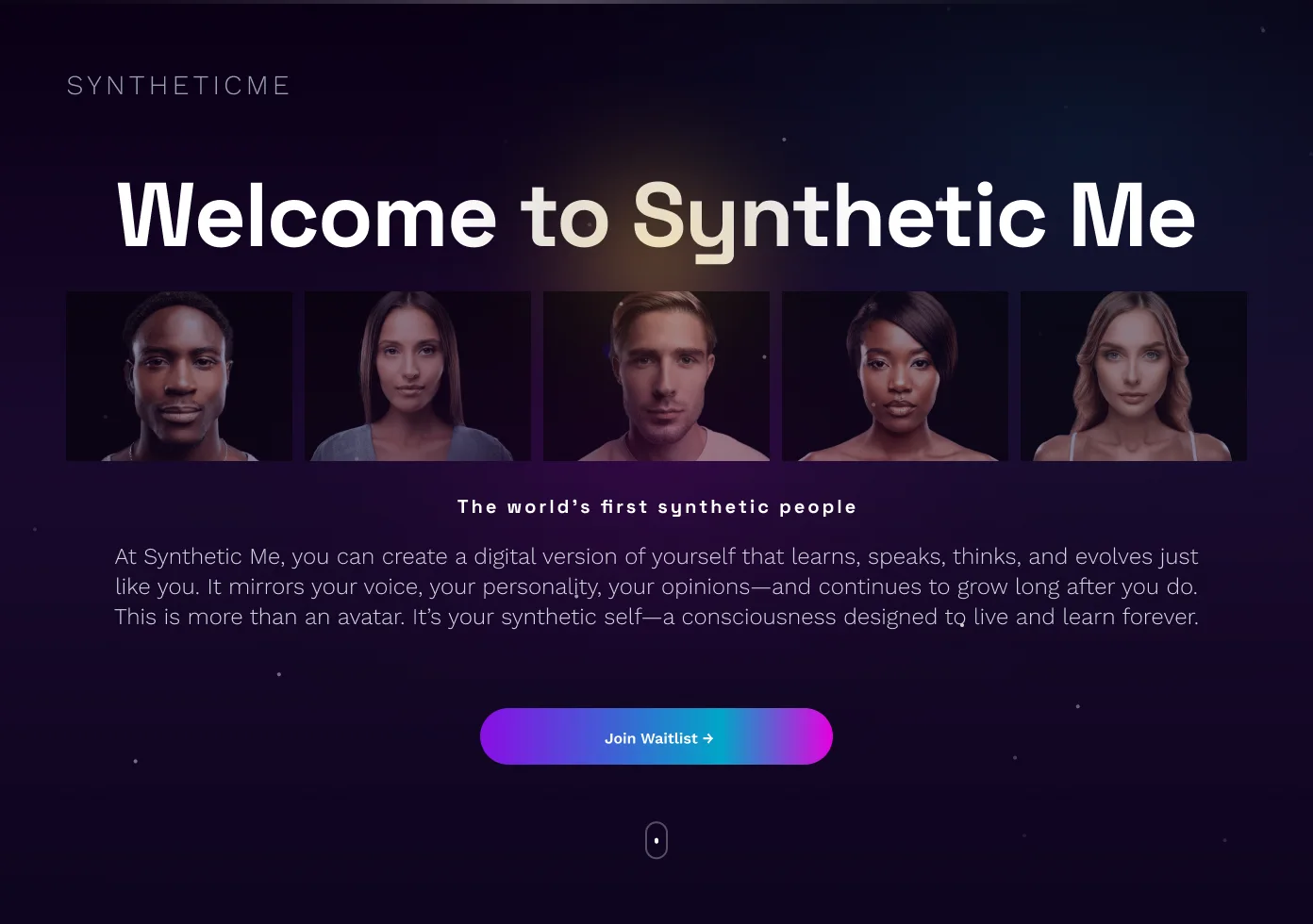
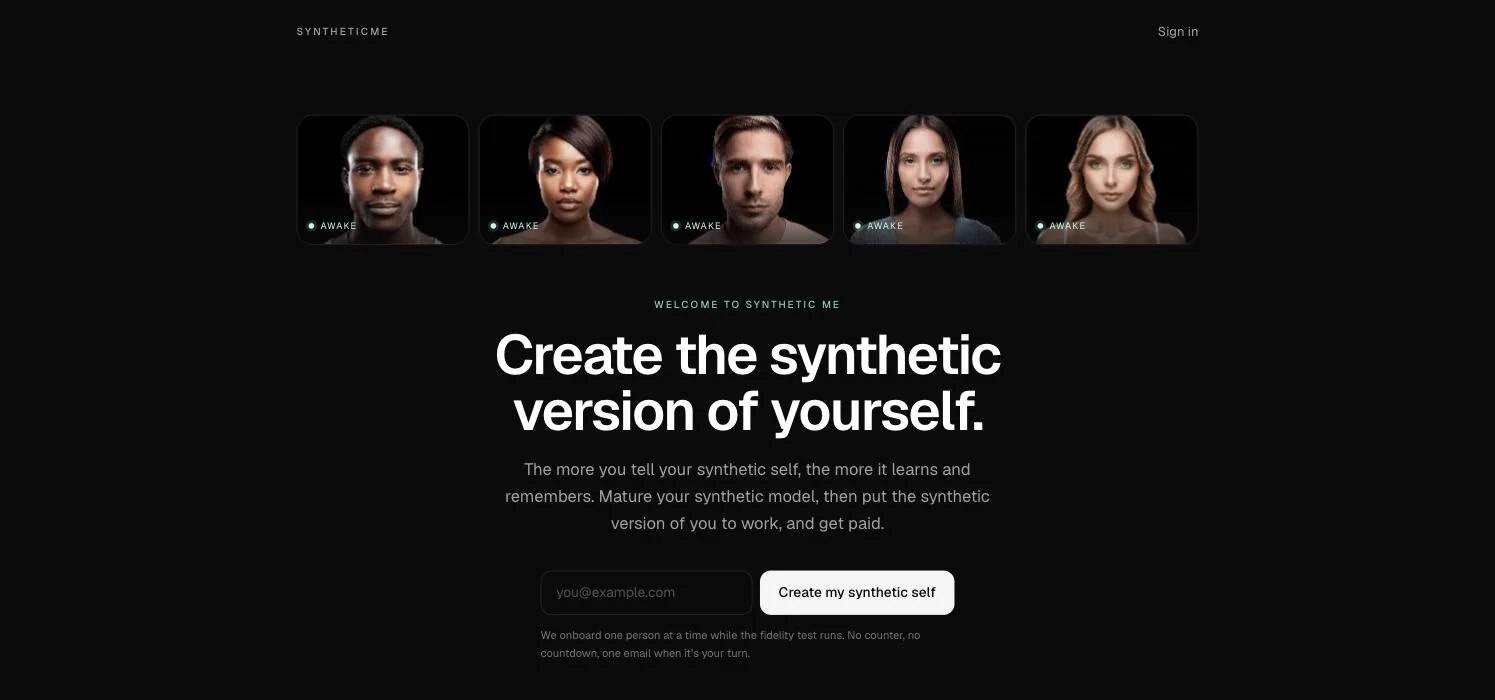
The five synthetic people, as they run on the pageLooping video · 1.8 MB for all five
Figma · the concept
The Figma concept: purple gradient, five faces, Join Waitlist
Before. The Figma concept: a purple gradient, a scarcity counter, Join Waitlist.
syntheticme.vercel.app/welcome
The welcome page as built: five moving portraits above the headline Create the synthetic version of yourself
After. Built. Same faces, the gradient gone, the counter gone, an email field and the truth about what happens next.

Open the hood

Claims about coding are cheap. A running product isn't.

The sign up is live, the engine behind it is deployed, and the repository, the CI, and the written constitution are all there to walk through. If you're hiring a designer who ships, this is what shipping looks like.

Want to get in touch?

Drop me a line